Asphalt Pavement Contractors In Columbus NE
Finding a reliable paving partner in Platte County can feel like a surprisingly steep challenge. You might notice that while there are plenty of general construction firms, dedicated asphalt specialists are somewhat rarer on the ground in Columbus itself. This often leads property owners to look toward established companies that serve the broader region, bringing big-city expertise to local projects. Whether you manage a sprawling industrial complex or just need a simple residential driveway fix, understanding the landscape of local contractors is step one.
The Local Contractor Landscape
It is not always easy to distinguish between a generalist and a true specialist. Many outfits claim they can handle blacktop, but asphalt requires specific machinery and temperature control that general handymen simply do not possess. In Nebraska, where the freeze-thaw cycle is particularly brutal, the difference between a professional job and a "quick fix" becomes obvious after just one winter.
You might find that the best crews for your job aren’t strictly headquartered next door. Many top-tier teams operate out of larger hubs like Omaha but consider Columbus a core part of their service territory. They bring the heavy equipment—pavers, rollers, and milling machines—right to your site. This ensures you get industrial-grade results rather than a patch job from a pickup truck.
Commercial vs. Residential Scope
Defining Your Project Needs
A commercial parking lot is a different beast entirely from a home driveway. The traffic load on a grocery store lot or an industrial loading dock requires a thicker layer of asphalt and a more robust sub-base.
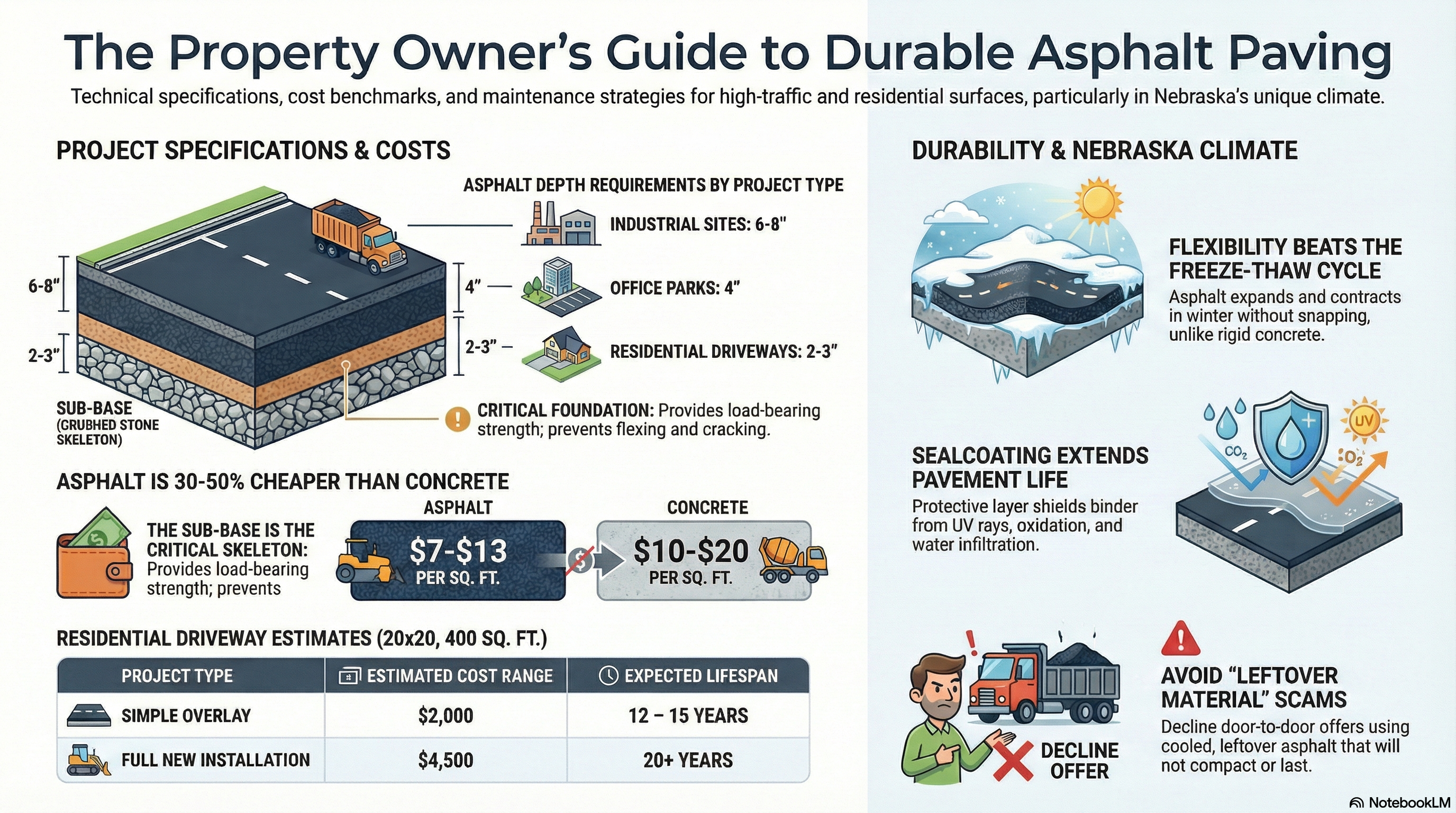
- Heavy Duty: Industrial sites need 6-8 inches of depth.
- Light Duty: Office parks might get away with 4 inches.
- Residential: Driveways often use 2-3 inches.
Why Specialization Matters
Commercial asphalt paving company crews understand ADA compliance, fire lane markings, and proper drainage flow for large surface areas. A residential driveway paver might not have the laser-grading equipment necessary to ensure a 50,000-square-foot lot drains correctly. Conversely, a massive highway crew might find a small driveway too insignificant to schedule. Finding the "Goldilocks" contractor—one big enough to be capable but small enough to care—is the goal.
Core Services to Look For
New Installation
This is the big job. It involves excavating the site, grading the soil, laying the stone base, and applying the hot mix. If you are building a new facility, this is where you start.
Resurfacing (Overlays)
Perhaps your surface is gray and cracking, but the foundation is solid. An overlay involves applying a new layer of asphalt over the old one. It is cheaper than removal and replacement, but it only works if the base is still intact.
Repair and Patching
Potholes are liabilities. A good contractor can cut out the damaged area and replace it with fresh hot mix, sealing the edges to prevent water infiltration.
The "Hidden" Layer: Sub-base Importance
What Lies Beneath
If you ask, "What do you put down before asphalt?" the answer usually involves a lot of crushed stone. The sub-base is arguably more critical than the blacktop itself. It acts as the load-bearing skeleton of your pavement. Without a stable, compacted aggregate base, the asphalt will simply flex and crack under the weight of a vehicle.
Soil Conditions in Platte County
Local soil can vary. In some areas, you might hit clay, which retains water and shifts when it freezes. A knowledgeable contractor will test the subgrade (the natural soil) and may need to undercut—remove unstable soil—and replace it with stable fill before laying the stone base. This step prevents the "alligator cracking" you often see on poorly built roads.
Cost Realities: Asphalt vs. Alternatives
The Price of Paving
Budget is always the friction point. People often ask, "Is asphalt cheaper than paving?" Generally, yes. Concrete or paver bricks are significantly more expensive upfront.
- Asphalt: Typically costs $7 to $13 per square foot.
- Concrete: Can run $10 to $20 per square foot.
- Pavers: Often exceed $25 per square foot.
The 20x20 Driveway Question
A common benchmark query is, "How much does a 20x20 asphalt driveway cost?" A 20x20 area is 400 square feet.
- Low End: Around $2,000 for a simple overlay.
- High End: Up to $4,500 for full excavation and new installation. These numbers fluctuate based on oil prices and trucking distance, but they serve as a decent rough estimate.
Longevity and Maintenance Cycles
Expected Lifespan
Nothing lasts forever, especially under the Nebraska sun. However, a well-installed asphalt surface should give you 20 to 25 years of service.
- New Install: 20+ years.
- Overlay: 12–15 years.
The Overlay Lifespan
"How long will an asphalt overlay last?" is a frequent concern. If the underlying structure is sound, you can expect 8 to 15 years. If the contractor overlays a lot that is already crumbling from below, you might only get 3 or 4 years before cracks reflect through the new surface.
Sealcoating Necessity
To get that maximum lifespan, you must sealcoat. This liquid protective layer shields the binder from UV rays and oxidation. Without it, the surface turns gray, becomes brittle, and starts to unravel.
Supply Chain: Where Materials Originate
Domestic Production
It is interesting to consider, "Where does the US get asphalt from?" Contrary to some beliefs about foreign oil dependency, the vast majority of asphalt binder used in the US is produced domestically.
- US Refineries: Supply about 88% of the market.
- Canada: Provides most of the remainder. The aggregate (stone and sand) is almost always sourced locally to keep transport costs down. So, your driveway is likely made of American oil and Nebraskan stone.
Famous Faces from Columbus
A Brief Detour
While we are discussing the local area, it is worth noting that Columbus has produced some genuinely notable figures. "Are there any famous people from Columbus, NE?" Indeed.
- Andrew Higgins: The man who designed the landing craft (Higgins Boats) that were crucial in WWII.
- Evan Williams: A co-founder of Twitter, shaping how the world communicates.
- Frank Phillips: Founded Phillips Petroleum, which ironically ties back to the very asphalt industry we are discussing. It is a small city with a surprisingly large footprint on history and industry.
Weathering the Nebraska Climate
The Freeze-Thaw Enemy
Water is the enemy of pavement. When water seeps into cracks, freezes, and expands, it acts like a slow-motion jackhammer. This is why drainage is paramount. A contractor must grade the surface so water runs off immediately.
Summer Heat
In July, blacktop can reach temperatures of 140°F or higher. This makes the material softer. Heavy trucks turning their wheels on fresh, hot asphalt can scuff or indent the surface. A reputable contractor will advise you to keep heavy traffic off a new lot for at least 24 hours, sometimes longer in peak summer.
Evaluating a Contractor's Quote
Reading the Fine Print
When you get a quote, do not just look at the bottom line. Compare the specs.
- Compacted Thickness: Ensure the quote specifies the thickness after compaction, not before. 3 inches of loose asphalt compacts down to about 2.5 inches.
- Warranty: What is covered? Material failure? Drainage issues?
- Equipment: Are they using a paver, or just spreading it by hand? (Hand spreading is fine for patches, bad for large areas).
Red Flags
Be wary of "leftover material" scams. If someone knocks on your door claiming they have extra asphalt from a nearby job and can pave your driveway cheap, politely decline. That material is likely already cooling down and will not compact correctly, leaving you with a crumbling mess in six months.
Common Paving Issues in Nebraska
Alligator Cracking
This looks like reptilian skin scales. It indicates structural failure in the sub-base. Filling these cracks is a waste of money; the affected area must be cut out and rebuilt.
Depression and Birdbaths
Puddles that stand on your pavement after a rainstorm are called birdbaths. They hasten deterioration. They are usually caused by poor compaction during installation or a shifting subgrade.
Frequently Asked Questions
FAQ Section
How soon can I drive on my new asphalt?
You should wait at least 24 hours before driving on a new surface. In very hot weather, extending this to 48 hours is safer. The material needs time to cool and harden. Driving too soon can cause tire tracks, ruts, and power steering scuffs that are difficult to fix.
Is asphalt better than concrete for Nebraska winters?
Asphalt has more flexibility than concrete, which allows it to expand and contract slightly during freeze-thaw cycles without snapping. Concrete is more rigid and prone to cracking in shifting soils. Additionally, blacktop absorbs heat, melting snow and ice faster than white concrete, which is a practical benefit in winter.
Can I pave over my existing concrete driveway?
Technically, yes, but it is risky. Concrete has expansion joints that will eventually reflect through the asphalt, causing cracks. The rigid concrete base can also shift differently than the flexible asphalt top. Most reputable contractors recommend removing the concrete entirely to build a proper flexible pavement structure from the ground up.
Why does my new driveway look scuffed?
Scuffing is normal on fresh asphalt, especially from power steering turns on hot days. The material is still somewhat pliable. These marks usually fade over time as the surface oxidizes and hardens. Avoiding stationary dry steering (turning the wheel while the car is stopped) helps minimize this issue significantly.
Final Thoughts on Your Project
Choosing to pave or repave is a significant investment in your property's value and functionality. Whether you are managing a retail parking lot or upgrading your home's curb appeal, the quality of the installation determines the return on that investment. Don't settle for the first name you find in the phone book. Look for experience, clear communication, and a detailed plan of action.
A well-paved surface is something you shouldn't have to think about for decades. It should just work—draining water effectively, providing a smooth ride, and looking professional. If you are ready to move forward, ensure you are partnering with a team that views your project as a long-term relationship, not just a one-off transaction.
Ready for a Smooth Surface?
Does your property need a professional touch? Parking Area Maintenance, Inc brings over 40 years of veteran-owned experience to the table, delivering high-quality asphalt paving services across the region. Contact us today to discuss your needs and secure a surface built to last.https://www.parkingmaintenanceomaha.com/
Related Articles:
Asphalt Pavement Contractors in Omaha NE
Asphalt Pavement Contractors In Council Bluffs
Asphalt Pavement Contractors In Lincoln NE
Asphalt Pavement Contractors In Fremont NE